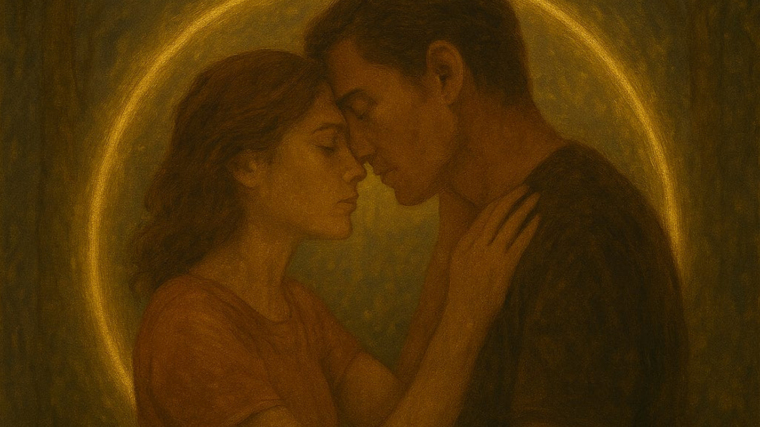


Lately I’ve been sitting with grief again not only in the loss of loved ones, but in the many endings life asks us to face.
I have been sitting with grief not as an idea, but as a living presence that moves through me. Grief has reshaped me in ways I could never have chosen, and yet it has brought teachings I could not have found anywhere else.
Pain is real. It arrives uninvited and tears through the fabric of what we thought we knew. It breaks us open, and sometimes it feels merciless in its timing and its weight. But suffering, I have learned, is different. Suffering comes when we resist, when we fight against what is, when we cling to what we cannot change.
In the work I do, grief is seen as a movement of life itself something that doesn’t come to destroy us, but to re-order us. It rearranges the constellation of our soul, making space for a new order that can hold both love and loss.
When someone passes, their journey continues, and ours shifts. Life asks us to hold both truths at once: to honour the one who has gone and to honour the life that still moves in us. This is not about replacing, forgetting, or “moving on.” It is about bowing to the fact that love changes form, and in doing so, it changes us.
Inanna’s Descent
The Sumerian goddess Inanna once journeyed into the underworld, leaving behind her throne, her crown, her jewels, and her robes. At each gate she passed through, she was asked to surrender another layer of who she believed herself to be. Finally, she stood naked in the realm of death, stripped of all but her essence.
This is the path of grief. It takes from us what we cling to the roles, the stories, the attachments — until we are laid bare. It humbles us, strips us of illusions, and demands that we meet life without armour. But in that nakedness, something is revealed: a truth that could not be seen when we were still clothed in certainty.
Like Inanna, we emerge changed. Not as who we once were, but as someone who carries the imprint of the descent someone who knows both loss and the strange grace hidden inside it.
Grief also reminds us of the deeper laws of life: that death is not a mistake, that endings belong as much as beginnings, and that we are all woven into the fabric of something greater than our own story. When we align with this truth, suffering begins to soften. Pain remains, but it becomes bearable, because we recognise we are not alone in it we are part of a larger order that holds both life and death.
And in this alignment, gratitude can appear. Gratitude for the moments we were given, gratitude for the breath still in our lungs, gratitude for the love that made grief possible in the first place.
Grief has taught me to bow. To bow to what is bigger than me. To bow to the reality that life and death belong equally. And to bow in thanks, even when the heart aches.
This bowing does not take away the pain. But it does dissolve the suffering, leaving in its place something quieter, something more enduring: a deep belonging to life as it is.
Grief also reminds us of the deeper laws of life: that death is not a mistake, that endings belong as much as beginnings, and that we are all woven into the fabric of something greater than our own story. When we align with this truth, suffering begins to soften. Pain remains, but it becomes bearable, because we recognise we are not alone in it we are part of a larger order that holds both life and death.
And in this alignment, gratitude can appear. Gratitude for the moments we were given, gratitude for the breath still in our lungs, gratitude for the love that made grief possible in the first place.
Grief has taught me to bow. To bow to what is bigger than me. To bow to the reality that life and death belong equally. And to bow in thanks, even when the heart aches.
This bowing does not take away the pain. But it does dissolve the suffering, leaving in its place something quieter, something more enduring: a deep belonging to life as it is.
Honouring Death in All Its Forms
There are many kinds of death in a lifetime. The death of a loved one is perhaps the most visible, but there are also the quieter deaths: the ending of a relationship, the loss of innocence, the closing of a chapter, the letting go of an identity we once held dear.
Each of these endings deserves to be honoured. When we resist them, suffering deepens. But when we bow to them, we make space for life to flow again.
In the work I share, there is a deep respect for both beginnings and endings. Death is not seen as a mistake, but as part of the natural order of things. To honour death — in all its forms — is to honour life itself.
Grief, then, is not only a burden but also a doorway. A doorway into acceptance, humility, and the quiet gratitude of being alive.
Grief as Communal
Francis Weller writes that grief has “five gates” the deaths of those we love, the parts of ourselves we never got to live, the sorrows of the world, the losses that come with change, and the ancestral grief we carry. He reminds us that grief is not a private matter but a communal one that it requires ritual, witness, and a place to be poured out.
This has been true in my own journey. Alone, grief can feel unbearable. But when it is witnessed, when it is given space, it transforms. It becomes less of a weight and more of a river, moving us back into belonging with life, with others, and with ourselves.
A Personal Note
For me, grief is not abstract. It has marked my path with the loss of my daughter, Phoenix, and with many other quieter deaths chapters of myself and my life that have ended before I was ready. These moments have broken me open, but they have also taught me the deepest truths of my work: that death and life are woven together, and that gratitude can coexist with heartbreak.
It is not an easy teaching to carry. But it is one that keeps calling me back to the ground of my being to bow, to breathe, to live in reverence for what is here, and for what has been.
Reflection for You
Where in your own life are you being asked to honour an ending not to rush past it, not to fix it, but simply to bow?